Shockwave Therapy: What It Does, Who It Helps
Shockwave therapy is often described as a way to “break up scar tissue” or restart healing. That shorthand is appealing, but incomplete. The treatment uses acoustic energy on a painful area, usually a tendon, muscle, or other musculoskeletal tissue, to influence pain and the body’s repair response. It is not surgery, and it is not a guaranteed fix for every persistent injury.
The more useful question is whether the problem is suitable for this treatment in the first place. Shockwave therapy is generally considered for ongoing tendon or sports-related pain that has not improved enough with conservative care, although the right choice depends on the diagnosis rather than the label “chronic pain.”
At True Health Chiropractic and Acupuncture, the evaluation is described as looking at the painful area, movement patterns, and reasons the problem keeps returning before creating a treatment plan. The practice serves patients in Lombard and nearby communities, including Glen Ellyn, Wheaton, Downers Grove, Elmhurst, and Villa Park.
Start with the diagnosis, not the machine
Shockwave therapy is also called extracorporeal shockwave therapy, or ESWT. Some clinics use the term EPAT—extracorporeal pulse activation technology—though terminology varies by device and provider.
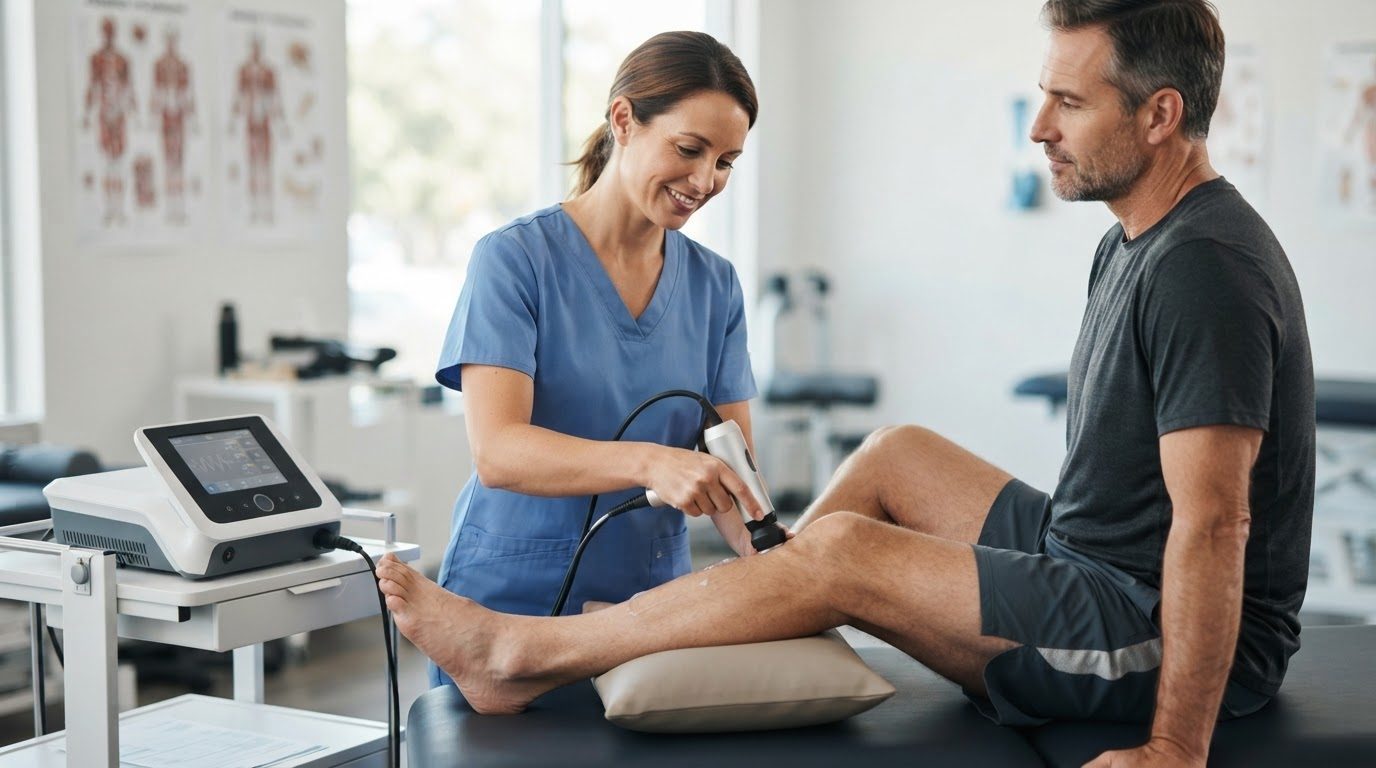
A handheld applicator delivers acoustic pulses through the skin. Depending on the machine, the waves may be focused at a particular depth or delivered more broadly across tissue. A gel helps the applicator move over the skin and transmit the energy.
The proposed effects include:
- Changing pain signaling in the treated area.
- Encouraging local biological activity involved in tissue repair.
- Increasing blood flow and stimulating growth-related responses.
- Affecting calcific deposits in some degenerative tendinopathies.
Those mechanisms are still being studied, and the treatment should not be presented as literally “repairing” every damaged structure. A painful tendon might be responding to overload, weakness, altered movement, a partial tear, nerve irritation, or a different condition altogether. If the underlying problem is misidentified, acoustic waves are unlikely to solve it.
A proper assessment may include a physical examination and, when appropriate, imaging such as ultrasound. That is especially relevant when symptoms are severe, persistent, or accompanied by weakness, swelling, a traumatic injury, or a loss of normal function.
Which problems are most often considered?
The strongest everyday use of shockwave therapy is in selected musculoskeletal conditions, particularly stubborn tendon disorders. It is often discussed for plantar fasciitis and other chronic tendon problems, as well as certain sports injuries. It may also be used around some muscle, joint, or bone-related conditions, but the evidence and treatment approach differ by diagnosis.
Shockwave therapy is not simply a general treatment for “inflammation.” Pain may continue after an injury even when inflammation is no longer the main driver. Likewise, a treatment that helps one tendon condition may not be appropriate for a fracture, a nerve problem, or a nearly torn ligament.
A reasonable candidate is usually someone whose symptoms have been evaluated and whose condition has not improved adequately with measures such as activity modification, rehabilitation, strengthening, or other appropriate conservative treatment. That does not mean every patient must exhaust every alternative first. It means the treatment should fit a clear clinical problem.
The best results usually come from using shockwave therapy as part of a rehabilitation plan rather than treating it as a stand-alone event. If a tendon is overloaded by poor training progression or inadequate strength, reducing pain without addressing that load can leave the original problem in place.
What happens during a session?
Treatment is performed with the patient positioned so the clinician can reach the affected area. Gel is applied to the skin, and the applicator is placed over the target tissue. The pulses often sound like repeated clicks or tapping.
Discomfort is common because the device is working over an already sensitive area. Patients often describe pressure, tapping, or a sharp sensation rather than continuous pain. The clinician can adjust the energy level to keep the treatment tolerable. The experience may be more uncomfortable when the target lies close to bone.
A session is usually brief, and there is generally no incision, anesthesia, or formal recovery period. The exact protocol depends on the condition, the device, and the provider’s assessment. True Health’s patient information says that individual sessions last only a few minutes and that patients often notice relief within two or three treatments. Its guidance also says that meaningful improvement commonly occurs over three to six sessions, depending on the condition and how long it has been present.
Those figures are expectations, not a promise. A person with a long-standing tendon disorder may respond differently from someone with a newer sports injury, and improvement should be judged by function as well as pain.
What should you expect afterward?
Many people return to ordinary activity soon after treatment. That does not mean the tissue is instantly healed or that unrestricted heavy loading is sensible. The appropriate activity level depends on the injury and the rehabilitation plan.
Temporary soreness, bruising, swelling, or a short-lived increase in pain can occur. Ohio State’s patient information notes that an early reduction in pain may sometimes fade after a week or two before later improvement develops. This is one reason not to judge the treatment solely by how the area feels immediately afterward.
Ask the treating clinician:
- What activity is allowed on the day of treatment?
- Should strengthening or stretching change temporarily?
- Which symptoms are expected, and which require a call?
- How will progress be measured?
Pain relief is useful, but improved walking, grip, running tolerance, sleep, or range of motion may be a more meaningful sign that the plan is working.
Who should avoid it or seek extra assessment?
Shockwave therapy is noninvasive, but “noninvasive” does not mean risk-free. A clinician should review your medical history and the exact injury before treatment.
Extra caution or avoidance may be appropriate in situations such as:
- A suspected fracture or markedly reduced bone density, including osteoporosis.
- A tendon or ligament that is nearly or completely torn.
- Active infection, an open wound, or a tumor in the treatment area.
- Certain bleeding disorders or use of blood-thinning medication.
- Pregnancy when the proposed treatment area is near the abdomen or pelvis.
- Implanted devices or other medical circumstances that require individualized review.
The risks are usually limited, but rare complications can include significant bruising, bleeding, tissue irritation, or injury to vulnerable structures. A nearly torn tendon may be at greater risk if energy is applied without recognizing the extent of the damage. New weakness, substantial swelling, worsening pain, numbness, or inability to bear weight warrants prompt medical advice rather than another routine session.
Do not use a home device or purchase a machine based only on an online description. The name “shockwave” covers different technologies, energy levels, and treatment protocols. A device marketed for general pain relief is not a substitute for diagnosis.
What are the drawbacks?
The biggest drawback is uncertainty. Evidence is encouraging for several tendon and musculoskeletal conditions, but results are not uniform, and formal research is still developing for some applications. A treatment may reduce pain without correcting the mechanical reason the injury developed.
Other practical disadvantages include:
- The treatment can be uncomfortable.
- Improvement may take several weeks rather than appearing immediately.
- Multiple visits may be needed.
- It may not be covered by health insurance.
- It is not appropriate for every diagnosis.
True Health states that shockwave therapy is generally not covered by major medical insurance but is FSA/HSA eligible; coverage rules and account eligibility can change, so ask the practice for current, itemized information before beginning care. Avoid comparing its cost with surgery or injections unless you have received actual estimates for those alternatives and understand that they are not interchangeable treatments.
How successful is it?
There is no single, reliable success rate for “shockwave therapy.” Outcomes depend on the condition being treated, how it was diagnosed, symptom duration, the treatment protocol, and whether rehabilitation addresses strength and load management.
A clinic should be able to explain what improvement would look like in your case and when the plan will be reassessed. Be cautious of guarantees, claims that the treatment works for every type of pain, or promises that imaging findings such as scar tissue are the sole cause of symptoms.
A useful consultation includes a working diagnosis, realistic goals, possible alternatives, known risks, and a stopping or reassessment point if progress does not occur. If the explanation focuses only on the machine, that is not enough.
The practical takeaway
Shockwave therapy is best understood as a targeted option for selected musculoskeletal problems—not a universal pain treatment and not a replacement for diagnosis or rehabilitation. It may be worth discussing when a persistent tendon or sports-related injury continues to limit activity despite appropriate care.
Before booking, bring a clear history of when the pain began, what worsens it, prior treatments, medications—especially blood thinners—and any imaging results. Then ask what structure is being treated, why shockwave is suitable, how progress will be measured, and what happens if it does not help. Those answers matter more than the device’s marketing name.
